
Rats or mice? Why it matters which one you have
If you've found droppings in the basement or heard scratching noises in the walls at night, you probably have a rodent in the house. The next question is how to tell if you have rats or mice, and the answer matters more than most homeowners expect.
Rats and mice behave differently. They enter through different size openings, nest in different places, respond differently to traps and bait, and leave different signs behind. A plan built for mice can miss a rat problem completely, and the other way around.
Early detection matters too. A few mice in the garage after the first cold night is a much smaller job than an established population living in the walls, attic and basement. The sooner you identify what you're dealing with, the easier it usually is to get under control.
Broner Pest Control is a residential-focused pest control company with 15 years of experience, serving homes in Detroit and across Southeast Michigan. This guide explains the signs we look for, how to tell rats and mice apart, and when it makes sense to call for help.
7 warning signs of a rodent infestation
Most homeowners never see the rodent first. They see what it leaves behind. These are the seven most common signs of mice in your house, and of rats too.
Seeing signs of rodents? Get a plan for your home.
Talk to Broner Pest Control about the mouse activity you're seeing and the next steps for your home.
Call 734-608-3435Request an Inspection1. Droppings
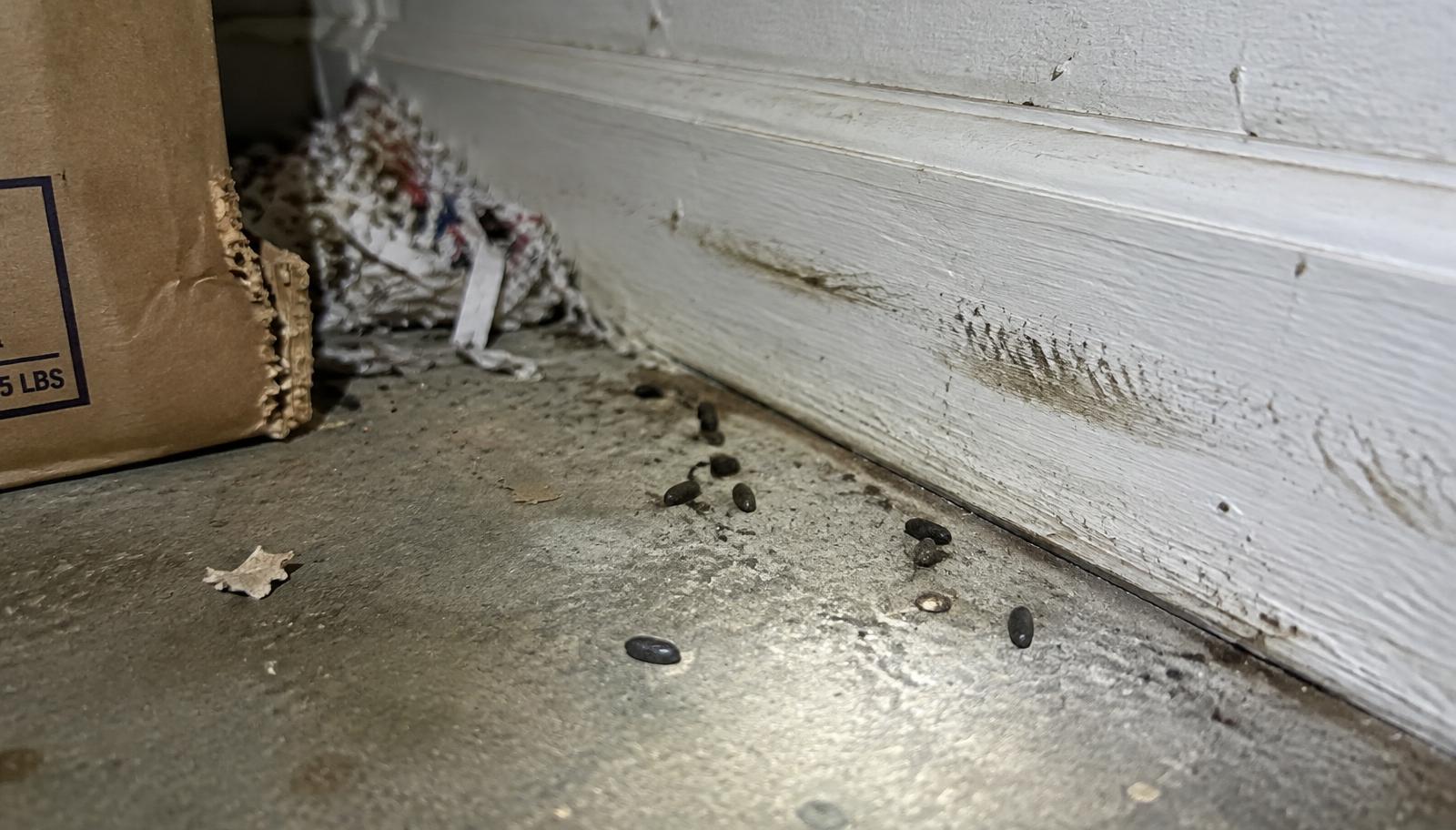
Droppings are the most reliable sign of a rat or mouse infestation. Look in kitchen drawers, under the sink, behind the stove and refrigerator, on pantry shelves, along basement walls and in the garage. Fresh droppings are dark and soft; older droppings are dry, gray and crumbly. Size and shape give you a clue about which rodent you have (see the droppings comparison below).
2. Scratching noises in walls at night
Light scratching, scurrying or gnawing inside walls, ceilings or under floors after the house goes quiet is one of the classic signs of rodents in walls. Mice tend to make light, quick sounds. Rats are larger and can make heavier thumping or dragging noises, often in attics, ceilings or along basement sill plates.
3. Gnaw marks
Rodents chew constantly to keep their teeth worn down. Look for chew marks on food boxes, cabinet corners, baseboards, door edges, plastic bins and sometimes wiring. Mouse gnaw marks are small and fine. Rat gnaw marks are larger and rougher, and rats can chew through tougher material.
4. Nesting materials
Shredded paper, fabric, cardboard or insulation gathered into a loose pile in a quiet spot, such as a storage box, behind an appliance, in a wall void or in the attic, usually means rodents are living in the home and not just passing through.
5. Damaged food packaging
Chewed corners on cereal, rice, crackers, flour, pet food, birdseed or grass seed are a strong sign. Pet food and birdseed stored in garages and basements are some of the most common targets in Michigan homes.
6. Unusual pet behavior
Cats and dogs often notice rodents before people do. A pet that stares at one wall, paws under the stove, or sniffs the same cabinet over and over may be reacting to activity you can't see or hear.
7. Greasy rub marks or tracks
Rodents travel the same routes along walls every day. Oil and dirt from their fur leave dark smudges along baseboards, corners, pipes and the edges of the openings they use. In dusty areas such as basements and garages, you may also see small footprints or tail drag marks.
Rat vs. mouse: how to tell them apart
In Southeast Michigan homes, the rodents we most often see are the house mouse, deer mice in some garages and outbuildings, and the Norway rat (also called the brown rat). If you catch a glimpse, or find one in a trap, these are the main differences:
| Feature | House mouse | Norway rat |
|---|---|---|
| Body size | Small: about 2½–3½ inches long, not counting the tail | Large and heavy: about 7–10 inches long, not counting the tail |
| Ears | Large compared to the head | Small compared to the head |
| Tail | Thin, about as long as the head and body | Thick, scaly, usually a bit shorter than the head and body |
| Snout | Pointed | Blunt and rounded |
| Entry gap | About ¼ inch, roughly the width of a pencil | About ½ inch, roughly the size of a quarter |
| Behavior | Curious; explores new objects and travels short distances from the nest | Cautious; often avoids new objects at first, burrows and travels farther for food and water |
| Common areas | Kitchens, walls, cabinets, attics, garages | Basements, crawl spaces, foundations, garages, outdoor burrows near the house |
What about young rats?
A young rat can look a lot like an adult mouse. The quickest tells are the head and feet: young rats have large heads and feet compared to the body, while mice look more evenly proportioned.
Rat vs. mouse droppings
Knowing how to identify mouse droppings, and how they differ from rat droppings, is often the most practical way homeowners figure out what they have.
| Mouse droppings | Rat droppings | |
|---|---|---|
| Size | About ⅛–¼ inch, similar to a grain of rice | About ½–¾ inch, similar to a raisin or olive pit |
| Shape | Thin with pointed ends | Thicker, capsule-shaped, often with blunt ends |
| Where found | Scattered along walls, in drawers, cabinets and pantry shelves | Often grouped in fewer spots along travel routes, in basements and garages |
Droppings alone may not settle it
Size varies with age, diet and how fresh the droppings are, and some insects and other animals leave similar-looking pellets. Droppings are a strong clue, not proof. Combine them with other signs, such as gnaw size, noise and where the activity is, or have a professional take a look.
Whatever you find, don't sweep or vacuum droppings dry. Wear gloves, wet them with a disinfectant or a bleach and water solution, let it soak, then wipe up with paper towels and seal them in a bag, following current CDC rodent cleanup guidance.
Where rats and mice hide
Rodents look for spots that are dark, quiet, protected and close to food and water. In Michigan homes, the most common hiding places are:
- Basements: along the sill plate, near the furnace and water heater, in storage boxes and in unfinished ceilings.
- Attics: in insulation, along the roofline and near soffits and vents.
- Garages: around stored pet food, birdseed, grass seed and boxes, and at gaps under the garage door.
- Kitchens: behind and under the stove, refrigerator and dishwasher, in lower cabinets and under the sink.
- Crawl spaces: often quiet, undisturbed and close to the foundation.
- Utility openings: gaps where gas lines, water lines, cable, dryer vents and AC lines go through the walls.
- Wall voids: warm, protected spaces that connect different parts of the home, which is why scratching noises in walls are so common.
Why rodents enter Michigan homes
Rats and mice live outdoors through the warmer months. As temperatures drop in fall and winter, outdoor food gets harder to find and shelter becomes more important. A heated house offers warmth, food and protected nesting space, so rodents look for a way in.
The way in is usually small. Common entry points include gaps around utility lines, foundation cracks, worn door sweeps and garage door seals, damaged vents, and openings at the roofline. Mice can get through a gap about the width of a pencil; rats need a little more room but are strong chewers and can widen openings.
Older homes in Detroit, Dearborn, Redford and Westland often have settled foundations and older utility penetrations. Newer homes in Novi, Canton and Northville can still have gaps around garage doors, siding and utility lines. In both cases, it's the small openings, not the age of the house, that matter most.
Are rats or mice dangerous?
Rodents are more than a nuisance, but there's no need to panic. Here are the real concerns:
- Food contamination: rodents contaminate food and surfaces with droppings, urine and hair. Food they've gotten into should be thrown out.
- Property damage: chewing damages stored items, insulation, wood, drywall and plastic, and nesting can soil insulation over time.
- Electrical wiring: rodents sometimes chew wiring. Damaged wires can be a fire hazard and should be checked by a qualified electrician.
- Health concerns: according to the CDC, rodents can spread diseases through their droppings, urine and saliva. Hantavirus is mainly associated with deer mice, and leptospirosis with rats. Safe cleanup and keeping rodents out of living areas lower these risks.
Can you get rid of rats and mice yourself?
For a small, recent problem, sometimes yes. These steps help with any rodent problem:
- Store pantry food, pet food and birdseed in sealed hard plastic, glass or metal containers.
- Clean crumbs under appliances, don't leave pet food out overnight, and fix leaky pipes.
- Reduce clutter in basements, garages and attics, and keep stored items off the floor.
- Seal gaps with materials rodents have trouble chewing through, such as copper mesh, hardware cloth and sealant. Replace worn door sweeps and garage seals.
- Set snap traps along walls where you've seen droppings or rub marks, with the trigger end facing the wall, and check them daily.
Limits and safety of DIY
Traps remove rodents already inside, but they don't stop new ones from coming in. Rats are often cautious around new objects, so they may avoid traps for days. Store-bought baits can be a risk to children and pets, and a rodent that dies inside a wall can cause odor problems. If you're catching rodents week after week, the entry points haven't been found. For more detail on mice specifically, read how to get rid of mice in your Detroit home.
When to call a professional exterminator
It's time for professional rodent removal when:
Seeing signs of rodents? Get a plan for your home.
Talk to Broner Pest Control about the mouse activity you're seeing and the next steps for your home.
Call 734-608-3435Request an Inspection- You keep seeing rats or mice, or you've seen one during the day.
- Droppings keep showing up after cleanup, or appear in more than one room or floor.
- You hear scratching noises in the walls or ceiling regularly.
- Nesting appears to be in places you can't reach, such as wall voids, attics or crawl spaces.
- Activity continues despite your DIY efforts.
- You think you may have rats, or you can't tell which rodent you have.
What professional rodent control involves
A professional inspection covers the interior, basement, garage, attic access, foundation and roofline to identify which rodent is active, where it's traveling, and the likely entry points. From there, a technician recommends an appropriate treatment and prevention plan, which can include targeted treatment, monitoring and recommendations for closing entry points.
If you're comparing options, our guide to mouse exterminator costs in Michigan explains what affects pricing, and our guide to the signs of a mouse infestation goes deeper on mice.
Residential rodent control in Southeast Michigan
Broner Pest Control provides rodent control, including mouse control and rat control, through annual service agreements: an initial service, followed by four quarterly services starting 30 days later. If rodents or other covered pests come back between visits, reservice is free.
We serve homeowners in Detroit, Dearborn, Livonia, Northville, Novi, Plymouth, Canton, Farmington Hills, Southfield, Redford Township, Westland and many surrounding communities. See all of our service areas.
Not sure whether you have rats or mice? Call Broner Pest Control at 734-608-3435 or request an inspection and we'll help you figure out what's going on and what to do next.
Frequently asked questions
How can I tell if I have rats or mice?
Compare the signs. Mouse droppings are small, about the size of a grain of rice, with pointed ends; rat droppings are larger, about ½ to ¾ inch, and capsule-shaped. Mice have big ears, pointed snouts and thin tails; rats are larger with small ears, blunt snouts and thick tails. Rat gnaw marks and noises are also bigger and heavier.
What do scratching noises in walls at night mean?
Scratching, scurrying or gnawing inside walls or ceilings after dark usually means rodents are traveling or nesting in wall voids. Light, quick sounds point toward mice; heavier thumping or dragging can point toward rats.
Is it possible to have both rats and mice?
Yes, though it's less common. Rats can prey on mice, so the two often don't share the same space, but a home can still have activity from both in different areas.
Will rats or mice go away on their own?
Rarely. Once rodents find food, warmth and shelter, they tend to stay and breed. Without removing them and closing entry points, activity usually continues or grows.
Why do I see more rodents in the fall in Michigan?
As temperatures drop, rats and mice look for warmth, food and shelter. Heated homes offer all three, and small gaps around utility lines, foundations, doors and the roofline give them a way in.
Should I vacuum rodent droppings?
No. CDC guidance advises against sweeping or vacuuming droppings because it can stir particles into the air. Wear gloves, wet droppings with a disinfectant or bleach solution, let it soak, then wipe up with paper towels and dispose of them in a sealed bag.
When should I call a professional for rats or mice?
Call when you see rodents repeatedly, droppings keep returning, you hear activity in walls or ceilings, nesting is in places you can't reach, you suspect rats, or DIY efforts haven't stopped the activity.
Learn more about our home page, rodent control, rat control, and general pest control. Call 734-608-3435 or email info@bronerpest.com to schedule an inspection.
Need help now? See our rodent control and mouse control and rat control services for Southeast Michigan homes.